
why am I competing for the title of most fucked-up?
confessions from therapy (pt. 1)

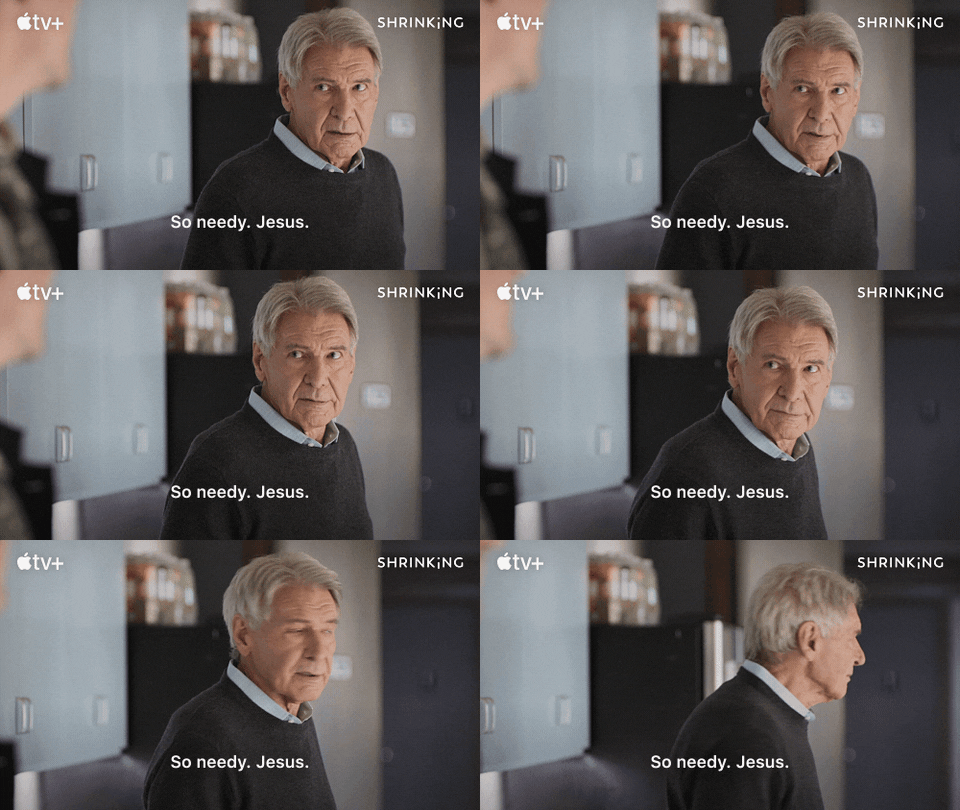
S(ubjective) — My Perspective
This week, I came into therapy with a story I was ashamed to admit.
Over the weekend, I was out to dinner with my husband (R), my mom, and my step-dad.
Quick context on R: he doesn’t have stellar parents. Mine have largely adopted him in the 10 years we’ve been together, and it’s an overall lovely thing in my life. But sometimes R grapples with his lack of knowledge about what parents are supposed to be to him. So, occasionally, when we all get together, the topic of parent-child dynamics comes up, sometimes R is the catalyst, and sometimes it’s me (talking largely about my Dad).
Recently, R had a conversation with his childhood nanny, where he asked her a host of questions about his dad, his birth mom, and what exactly went down between them when he was a kid. Things his dad has gaslit him about, and things he would never otherwise know about his birth mom.
And boy did she have answers, really f-ed up answers.
At dinner, R was spilling the tea, to put it informally, about some of what he learned, which inevitably kicked up our quartet’s usual parent-child discussions. Somewhere along the way, I classically brought up my Dad and, predictably, my mom defended him for the umpteenth time while my taciturn stepfather looked off into the distance.
The conversation naturally dwindled as food arrived, until a few moments later when my step-dad goes, “Well, R, I’ll tell you one thing. You definitely take the cake.” Meaning, you win for being the most traumatized among us.
And something inside me stiffened. I didn’t like that R was being acknowledged by my own parents as more traumatized than I.
While at the same time telling myself that was a totally delusional thing to think.
O(bjective) — Observable Data
As I’m coming to my shameful conclusion, I’m quick to wrap it up neatly.
“Obviously, that’s a ridiculous thing to think.”
“I would never want to compete with my husband for who is the most fucked up.”
“Regardless, my step-dad was right. R does take the cake.”
Dr. K sits in the silence that lingered after my confession and smiles slightly before giving the classic therapist retort of, “What came up for you emotionally in that moment?”
If I knew that, would I have brought it up in therapy? I grapple, trying to find the emotion hidden behind the torrent of thoughts tangling my understanding.
I shift on the couch and hug my arms around my torso and look anywhere but at her as I say, again feeling ashamed of my own inadequacy, “I really don’t know, dismissed, maybe?”
“Threatened?” she counters.
Oh. Yes, but… why?
A(ssessment) — What My Therapist Said
So we unpack it… how my fucked-up-ness was the only thing that got my parents’ attention when I was a kid, how it became part of my identity in my adolescence. It was, for a long time, what others found cool & interesting about me.
It’s also a taboo in my family. We don’t talk about the eating disorder that had me on the brink of death for all those years.
As far as my parents were concerned, one day I started eating again, and they could pat themselves on the back for a job well done.
So how then can my parents acknowledge R’s trauma with a simple colloquialism?
Somewhere in this discussion, a question occurs to me:
“Why does it feel so much more vulnerable to talk about myself outside of the ways in which I’m fucked up?” Why could I talk for hours about my experiences, trauma, and what they’ve taught me, but if you asked me what I like to do for fun, I would probably run away from you?”
Dr. K, ever with the words of wisdom in our last 10 minutes, responds, “The very qualities that make you beautiful and unique were a mirror reflecting what your parents couldn’t access in themselves. So they shut them down and shamed you to protect their own denial.”
“The creativity and intuition you likely demonstrated as a child threatened wounds within them, so they silenced those parts of you.”
P(lan) — What Now?
The part of therapy I find the most challenging is exactly this.
I pay someone to splay out my inner wounds, to dig and dissect until they’ve found the long-buried roots of my being.
Only for them to tell me the only way to tend to those roots is by accepting all of the ways they are gnarled together.
To leave them be, exactly as they are.
-June
I invite you to stay and be seen here.

for words with nowhere else to go
unspoken thoughts, unfinished feelings, & everything in between
your next read →
there's no such thing as a "waste of time"

“I don’t believe that time can be wasted,” a mind-boggling revelation delivered as a passive statement by my younger sister, P, in the middle of our weekly facetime.
confessions From Therapy (pt. 2)

SOAP notes are a standardized, four-part documentation method used by healthcare professionals to record patient encounters, standing for Subjective, Objective, Assessment, and Plan.
art by the incomparable talent on Pinterest